29th August 2025 - 4th January 2026

History of Blackpool Illuminations
Blackpool was already a well-established sea-side resort
long before the Illuminations came about. Prior to 1879
the streets were lit by gas light but in that year the Council devoted the
sum of £5000 to experiment with the concept of electric street lighting.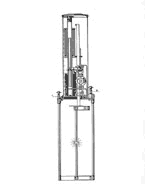 On the 19th September 1879 Dr Siemens' 8 dynamo-electric machines powered
by 16 Robey engines were used to power 8 arc lamps on the promenade spaced
320 yards apart, emitting the equivalent of 48,000 candles of light in total.
The event had been advertised nationally and between 70,000 and 100,000
visitors travelled from all over Britain to witness the event. The light
generated was called "artificial sunshine" and these were possibly the first
electric street lights in the world. The nearest to modern day displays
was staged on Princess Parade in May 1912 to mark the first Royal visit
to Blackpool. Princess Louise officially opened the new
section of promenade and as part of the celebrations of this event the Blackpool
electrical engineer was instructed to decorate the promenade in what was
then a "novel fashion of garland lamps".
On the 19th September 1879 Dr Siemens' 8 dynamo-electric machines powered
by 16 Robey engines were used to power 8 arc lamps on the promenade spaced
320 yards apart, emitting the equivalent of 48,000 candles of light in total.
The event had been advertised nationally and between 70,000 and 100,000
visitors travelled from all over Britain to witness the event. The light
generated was called "artificial sunshine" and these were possibly the first
electric street lights in the world. The nearest to modern day displays
was staged on Princess Parade in May 1912 to mark the first Royal visit
to Blackpool. Princess Louise officially opened the new
section of promenade and as part of the celebrations of this event the Blackpool
electrical engineer was instructed to decorate the promenade in what was
then a "novel fashion of garland lamps".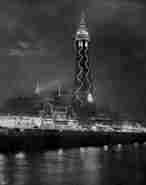 About 10,000 bulbs were used and the results were so impressive that the
local chamber of trade and other business people in the town persuaded the
Council to stage these lights again in September of that year. Thousands
of people visited the resort to see the illuminations and the event was
judged a commercial success. In 1913 the Council was again encouraged to
stage the Princess Parade lights as an after season event in September.
The response from the public was nothing short of astonishing but hopes
of building on this success was short lived with the outbreak of the First
World War the following year. Illuminations were back in
1925 on a more ambitious scale with lights festooned along the promenade
from Manchester Square to Cocker Square. It quickly became appreciated that
Blackpool Illuminations were a worthwhile tourist attraction
and they continued to be staged annually for many years. By 1932 animated
tableaux had been added and these were erected on the cliffs linking North
Shore and Bispham.
About 10,000 bulbs were used and the results were so impressive that the
local chamber of trade and other business people in the town persuaded the
Council to stage these lights again in September of that year. Thousands
of people visited the resort to see the illuminations and the event was
judged a commercial success. In 1913 the Council was again encouraged to
stage the Princess Parade lights as an after season event in September.
The response from the public was nothing short of astonishing but hopes
of building on this success was short lived with the outbreak of the First
World War the following year. Illuminations were back in
1925 on a more ambitious scale with lights festooned along the promenade
from Manchester Square to Cocker Square. It quickly became appreciated that
Blackpool Illuminations were a worthwhile tourist attraction
and they continued to be staged annually for many years. By 1932 animated
tableaux had been added and these were erected on the cliffs linking North
Shore and Bispham.
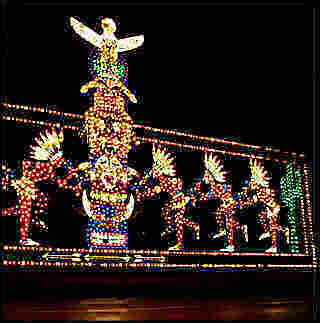 The length of the lights was extended to it's present length of just under
six miles from Squires Gate to Red Bank Road. In 1939, although the Illuminations
were ready for staging, they were prevented by the outbreak of the Second
World War. There was a full scale preview on August 31st complete with a
giant searchlight sweeping wide from the Tower top. But the next night the
blackout had been enforced and the only colour to be seen was inside hotels
and boarding houses where landladies had coloured their light bulbs with
dolly blue. Even after the war had finished there were restrictions on the
use of fuel and decorative lighting, consequently the Illuminations remained
prohibited. The austere climate of post-war Britain meant the Lights did
not come on again until 1949 when Anna Neagle pressed the switch, but only
after the Council were given permission by the Government to burn the required
amount of electricity. Since then the Illuminations have
been staged every year in the same format you see today. They are always
switched on at the end of August or beginning of September and currently
run for 66 nights. It is a popular misconception that the Illuminations
extend into the Christmas period but this has never in fact been the case.
The Illuminations are a temporary show and every feature
has to be taken down for maintenance at the Council's Rigby Road Depot.
So 126 years after it's birth the role of the Blackpool Illuminations remains
remarkably similar to it's origins. Held each year at the end of the summer
holiday season the Illuminations continue to attract literally
millions of people to the Town.
The length of the lights was extended to it's present length of just under
six miles from Squires Gate to Red Bank Road. In 1939, although the Illuminations
were ready for staging, they were prevented by the outbreak of the Second
World War. There was a full scale preview on August 31st complete with a
giant searchlight sweeping wide from the Tower top. But the next night the
blackout had been enforced and the only colour to be seen was inside hotels
and boarding houses where landladies had coloured their light bulbs with
dolly blue. Even after the war had finished there were restrictions on the
use of fuel and decorative lighting, consequently the Illuminations remained
prohibited. The austere climate of post-war Britain meant the Lights did
not come on again until 1949 when Anna Neagle pressed the switch, but only
after the Council were given permission by the Government to burn the required
amount of electricity. Since then the Illuminations have
been staged every year in the same format you see today. They are always
switched on at the end of August or beginning of September and currently
run for 66 nights. It is a popular misconception that the Illuminations
extend into the Christmas period but this has never in fact been the case.
The Illuminations are a temporary show and every feature
has to be taken down for maintenance at the Council's Rigby Road Depot.
So 126 years after it's birth the role of the Blackpool Illuminations remains
remarkably similar to it's origins. Held each year at the end of the summer
holiday season the Illuminations continue to attract literally
millions of people to the Town.